Archive for the ‘Borden Avenue Bridge’ Category
Magic Lantern Show in Ridgewood

Your humble narrator will be narrating humbly on Friday, February 24th at 7:30 P.M. for the “Ridgewood Democratic Club, 60-70 Putnam Avenue, Ridgewood, NY 11385” as the “Newtown Creek Magic Lantern Show” is presented to their esteemed group. The club hosts a public meeting, with guests and neighbors welcome, and say that refreshments will be served.
The “Magic Lantern Show” is actually a slideshow, packed with informative text and graphics, wherein we approach and explore the entire Newtown Creek. Every tributary, bridge, and significant spot are examined and illustrated with photography. This virtual tour will be augmented by personal observation and recollection by yours truly, with a question and answer period following.
For those of you who might have seen it last year, the presentation has been streamlined, augmented with new views, and updated with some of the emerging stories about Newtown Creek which have been exclusively reported on at this- your Newtown Pentacle.
For more information, please contact me here.
waxen mask

– photo by Mitch Waxman
Wandering aimlessly, that agglutination of wounds, phobias, and general wreckage which you might describe as a humble narrator recently found himself on the acclaimed Borden Avenue Bridge. The existential issues of life in the Big City are quite bothersome, and distract from pursuits of finer cast and higher intellectual firmament, but a fellow must eat (or be eaten). “Bucks, burgers, and beer” after all… it’s just the cold has gotten me down.
Problems maintaining biological homeostasis and personal comforts plague one’s patience during the winter months, for my dynamic equilibrium adjustment and regulation mechanisms are all ‘effed up.

– photo by Mitch Waxman
Hand wringing is a necessary pursuit for me during the frosts, as my feeble circulatory system cannot combat the normal vasoconstriction of extremities exposed to freezing temperatures, causing my fingers and hands to grow wan and bloodless. Looking like nothing but the curled and grasping claws of a cadaver, nervous feedback becomes intermittent, and it feels as if an amputation would bring nothing but minor discomfort.
Despite all this horror and ennui, I’m nevertheless compelled to wander the earth, and often find my steps have carried me to that sundering of natural law known as the Newtown Creek- or one its tributaries.

– photo by Mitch Waxman
The great thing about the Creeklands, and what always draws me back (and causes me to stop my whining self narrative and soliloquy of self pitying sophistry), is that there is always something you haven’t noticed- like the so called Freedom Tower rising over the two LIRR bridges which cross Dutch Kills. Wow.
This is the kind of thing that just keeps on bringing me around this place, despite the ravaged and ruinous condition of my physical incarnation.
the First Big Announcement

– photo by Mitch Waxman
Your humble narrator will be conducting a walking tour in Long Island City as part of the Open House NY Weekend on October 15 and 16. The tour will be approximately two hours in length, starts at 11 am, and will visit several of the amazing industrial landmarks which distinguish the Queens side of the Newtown Creek Watershed. Much of the walk will follow the Dutch Kills tributary of Newtown Creek. Reservations are required, which can be had by visiting the following link:
http://www.ohny.org/site-programs/weekend/programs/walk-down-newtown-creek
Oh, did I neglect to mention that this walking tour is free, as in gratis, as in no cost to you- Lords and Ladies?

– photo by Mitch Waxman
This is the first of two big announcements, the second is still under wraps and I’m not able to discuss it at this point. Hopefully, within the next couple of days, I’ll be able to say more. Open House NY weekend is a citywide event, and there are multiple opportunities to do cool and unique things. Please check out the rest of their offerings, but you definitely want to come on this exploration of a hidden and neglected waterway which is found less than one mile from midtown Manhattan.

– photo by Mitch Waxman
Bring a camera, of course, but I would be remiss if I didn’t advise you that broken pavement and largish puddles might be encountered- so proper (closed toe) footwear is advised. Additionally, this is as close to an urban desert as you are ever likely to find, so if you are one of the folks who likes to “stay hydrated”, bring a beverage along. Sparks deli on Borden Avenue will most likely be open, but one never can tell. Looking forward to seeing you along the Dutch Kills, and as always-
Want to see something cool?
Bring a camera, and ID…
Follow me…
uncommented masonry

– photo by Mitch Waxman
It all started when I was checking to see if I could find out anything more about the Blissville Banshee.
As the sum total of that which might be gathering dust on library shelves has not yet been digitized, categorized, and assigned metatags- there is an awful lot of stuff which is not available to the prying eyes of primarily nocturnal creatures like myself. Google books is an ongoing project, for instance, and every month or so some new (old) document appears online which is Newtown Creek oriented that I might slaver over.
from wikipedia
Google Books (previously known as Google Book Search and Google Print) is a service from Google that searches the full text of books that Google has scanned, converted to text using optical character recognition, and stored in its digital database. The service was formerly known as Google Print when it was introduced at the Frankfurt Book Fair in October 2004. Google’s Library Project, also now known as Google Book Search, was announced in December 2004.
Results from Google Book Search show up in both general web search at google.com and through the dedicated Google Books site (books.google.com). Up to three results from the Google Books index may be displayed, if relevant, above other search results in the Google Web search service (google.com).

– photo by Mitch Waxman
Hence my periodic searches conducted for topics of which I’ve heard only hints of in the past- Case’s Crew for instance, or the aforementioned Blissville Banshee. It was one of these fishing expeditions into the ever expanding archival universe of the vast inter webs that led me to a certain structure, which sits at 30-28 Starr Avenue, just a couple of blocks from that malignant exemplar of the price of unregulated capitalism known as the Newtown Creek. It’s ordinary enough looking, branded with corporate logos and quite visible from many parts of Long Island City and Brooklyn.
from the Friends’ intelligencer, Volume 35, courtesy google books
The early history of Friends in Newtown and Maspeth Kills is marred by the irregularities of the Ranters, who claimed to be Friends, and intruded on their meetings.
Such was Thomas Case, who (1674) was forbidden by the Court to entertain the wife of William “Smith. His wife, Mary Case, was fined £5 for interrupting Rev. William Leveridge, while preaching, by saying to him: “Come down, thou whited wall that feedest thyself and starvest the people.” Samuel Scudder sent a long, scandalous letter to Mr. Leveridge.
The Court put Case and Scudder under bonds not “to seduce and disturb the people.”

– photo by Mitch Waxman
Let’s start at the beginning, though.
Borden Avenue is one of the older pathways in New York and particularly so for Queens, as the modern street was designated as Borden Avenue in 1868. It allowed egress from the docks at Hunters Point to the incalculably far Newtown and passed by the thriving village of Maspeth along the way. Originally a plank road set roughly into the swampy lowlands which adjoined the Newtown Creek, what would become Borden Avenue eventually progressed to the point of regular horse drawn (and then electric) street car service by the late 19th century and beginning of the 20th. It became a natural place for heavy industries to gather, and in the 1870’s and 80’s, rail road switches and “rights of way” followed their customers here.
The Long Island Railroad terminal at Hunters Point is and was on Borden Avenue, and rail tracks run parallel to Borden Avenue’s path, along what would have once been known as Creek Street. Critically, these were both freight and passenger tracks.
As of 1908, a retractile vehicle bridge crossed Dutch Kills, which we call the Borden Avenue Bridge (and which replaced the earlier wooden plank road drawbridge).
Today Borden is severed and overran by the sprawling girders of the Queens Midtown Expressway section of the much larger “Long Island Expressway”, and most of the tracks which crossed it at grade are cut or buried in the road asphalt.
from wikipedia
The Long Island Expressway was constructed in stages over the course of three decades. The first piece, the Queens–Midtown Tunnel linking Manhattan and Queens, was opened to traffic on November 15, 1940. A highway connecting the tunnel to Laurel Hill Boulevard was built around the same time and named the “Midtown Highway”. The tunnel, the Midtown Highway, and the segment of Laurel Hill Boulevard between the highway and Queens Boulevard all became part of a realigned NY 24 in the mid-1940s. In the early 1950s, work began on an eastward extension of the Midtown Highway. The road was completed to 61st Street by 1954, at which point it became known as the “Queens–Midtown Expressway”. By 1956, the road was renamed the “Long Island Expressway” and extended east to the junction of Queens (NY 24 and NY 25) and Horace Harding (NY 25D) Boulevards. NY 24 initially remained routed on Laurel Hill Boulevard (by this point upgraded into the Brooklyn–Queens Expressway) and Queens Boulevard, however.

– photo by Mitch Waxman
Borden Avenue once formed the border of a community called Blissville (named for it’s founder and designer, Neziah Bliss of Greenpoint) which was meant to be an ideal residence for industrial laborers. It was, for a while.
Calvary Cemetery was sited in Blissville in 1848, which literally ate half the neighborhood, and the industrial concerns which employed the local labor had taken up valuable waterfront properties at the Newtown Creek. These industrial entities were notoriously onerous neighbors whose factories rendered Blissville a stinking slum and literally the wrong side of the tracks.
Dutch Kills and the land surrounding it to the south west were considered to be a pestilential swamp best known for malaria, and upstream from Blissville were the bone boilers and fat rendering factories so conspicuous in the historical record for a wholesale degradation of the environment. Suffice it to say that the population of Blissville declined precipitously from 1850 to 1900, from a residential point of view (although people still live here, even today).
from wikipedia
Blissville is a neighborhood in the New York City borough of Queens. It is part of Long Island City. It is bordered by Calvary Cemetery to the east; the Long Island Expressway to the north; Newtown Creek to the south; and Dutch Kills, a tributary of Newtown Creek, to the west. Blissville was named after Neziah Bliss, who owned most of the land in the 1830s and 1840s. Bliss built the first version of what was known for many years as the Blissville Bridge, a drawbridge over Newtown Creek, connecting Greenpoint, Brooklyn and Blissville. It was replaced in the 20th century by the Greenpoint Avenue Bridge, also called the J. J. Byrne Memorial Bridge, located slightly upstream.
Blissville existed as a small village until 1870 when it was incorporated with the villages of Astoria, Ravenswood, Hunters Point, Dutch Kills, Middletown, Sunnyside and Bowery Bay into Long Island City.

– photo by Mitch Waxman
At the end of the 19th and beginning of the 20th centuries, a Cambrian explosion of “scientific manufacturers” (which is an actual and atavist business terminology from the time) arose within the industrial quarters of the United States and especially around the Newtown Creek. Great corporations were born along the creek, in the fields of chemical manufacturing and metal refining, petroleum refining and distribution, electrical generation and supply, and especially the field of automotive vehicle manufacturing.
There were now machines that could fly, or mechanically navigate the seas, but it was the automobile which struck hardest in the public’s mind and ending up driving the national economy.
from wikipedia
By the early 1880 generators were beginning to power arc lamps in Britain and France, but they generated high temperatures and sparks that prevented widespread adoption. In 1880, Thomas Alva Edison developed and patented a long-lasting incandescent lamp based upon the previous work of many inventors. Like Bell, Edison immediately set about commercializing his invention through a shrewd business plan involving companies that would manufacture the whole technological system upon which the “light bulb” would depend – generators (Edison Machine Company), cables (Edison Electric Tube Company), generating plants and electric service (Edison Electric Light Company), sockets, and bulbs. As in other industries of the era, these companies achieved greater efficiencies by merging to form a conglomerated General Electric company. Lighting was immensely popular: between 1882 and 1920 the number of generating plants in the US increased from one in downtown Manhattan to nearly 4,000. While the earliest generating plants were constructed in the immediate vicinity of consumers, plants generating electricity for long-distance transmissions were in place by 1900. To help finance this great expansion, the utility industry exploited a financial innovation known as the “holding company”; a favorite holding company investment among many was the Electric Bond and Share Company (later much-changed, and known as Ebasco), created by the General Electric company in 1905. The abuse of holding companies, like trusts before it, led to the Public Utility Holding Company Act of 1935, but by 1920, electricity had surpassed petroleum-based lighting sources that had dominated the previous century.

– photo by Mitch Waxman
In an age before refrigeration, being a “locavore” wasn’t an ethical or fashionable choice, it was a necessity.
The speed of a horse and wagon could never be considered dependable though, especially when carrying a heavy load of perishables from say… Bosjwick to Blissville. Whether it was meat, milk, or especially beer- it had a quick shelf life whether it suffered under the gaze of the burning thermonuclear eye of god itself or endured the freezing temperatures of a New York winter.
Additionally, a horse needed rest and food and water, which all needed to be prearranged. Horses also had a tendency to die from overwork. The automotive craze began when the brewers of beer realized what some contrivance called a “truck” could do.
from wikipedia
The word truck might have come from a back-formation of truckle with the meaning small wheel, pulley, from Middle English trokell, in turn from Latin trochlea. Another explanation is that it comes from Latin trochus with the meaning of iron hoop. In turn, both go back to Greek trokhos meaning wheel from trekhein that meant “to run”. The first known usage of “truck” was in 1611 when it referred to the small, strong wheels on ships’ cannon carriages. In its extended usage it came to refer to carts for carrying heavy loads, a meaning known since 1771. With the meaning of motor-powered load carrier, it has been in usage since 1930, shortened from motor truck who dates back to 1916.

– photo by Mitch Waxman
The reason that so many parts of the Newtown Pentacle host a former brewery, not unlike the Ulmer site in Bushwick, is that Beer didn’t used to come in bottles or pressurized kegs but was instead shipped in barrels. These barrels were delivered daily, which meant that the brewer had to be centrally located to service the various saloons, beer gardens, and bars which formed it’s clientele. This called for an eternal struggle against random happenstance, and the relatively shallow load that a horse cart was capable of carrying created high labor and livestock costs and limited growth. Suffice to say that the beer brewers needed a more reliable form of transportation that could handle the heavy products they produced.
The automotive “truck” could work all day and night with one driver, and carry many times the tonnage possible with a carriage.

– photo by Mitch Waxman
Blissville had long ago rebelled against the baronial farmers of Newtown and joined with its ancient sisters in forming Long Island City, which would become an early center for automotive manufacture. The political elites of Manhattan, who had just engineered the consolidation of the City of Greater New York, were anxious to develop western Queens and land was cheap for the well connected. Vast building lots were sold, and an incredible landscape of titan masonry was flung at the sky, with the intention of capturing and controlling vast amounts of treasure and discovering untold possibilities.
from wikipedia
The City of Greater New York was a term commonly used originally to refer to the expanded city created on January 1, 1898 by the incorporation into the city of Richmond County, Kings County, Queens County, and the eastern part of what is now called The Bronx (east of the Bronx River). The west Bronx, west of the Bronx River, had been annexed to the City and County of New York in 1874, and was known as the Annexed District. The City of Brooklyn had also expanded by annexation.
The phrase City of Greater New York was never a legal or official designation as both the original charter of 1898 and the newer one of 1938 use the name of City of New York.
The consolidation movement was the work of several progressive politicians, most prominently Andrew Haswell Green so some opponents derided the effort as “Andy Green’s hobby.” The center of the plan was the consolidation of the twin cities of New York and Brooklyn, whose fire departments had already been consolidated. The addition of Long Island City and various rural areas anticipated the spread of urban sprawl to those areas. With the Republicans historically more powerful in Brooklyn and the Democrats elsewhere, partisan politics played a role, each major political party hoping to dominate the consolidated city.

– photo by Mitch Waxman
By 1915, there approximately 40,000 automotive trucks plying the streets of New York City.
What’s surprising is that 25% of them were electric.
Lords and ladies of Newtown, I present to you the last mortal remains of the General Electric Vehicle Company, 30-28 Starr Avenue, Long Island City– manufacturer of a substantial number of those electrical trucks.
Here’s the way the place looked just before the time of the first World War, courtesy google books
Another historic view can be seen in this nytimes.com archive article

– photo by Mitch Waxman
General Electric Vehicle Company was originally the Electric Vehicle Company, until it was acquired by one of those “scientific manufacturers”- a small but growing firm which called itself “General Electric“. GE was a direct creation of a fellow named Edison, whose little power generating concern in NYC hadn’t quite “consolidated” itself yet.
General Electric Vehicle, like all automotive companies, was in competition with an upstart from the midwest named Ford. Things hadn’t been decided yet, from a consumer point of view, between electric motors or gasoline ones, but there was another company out there which had strong feelings on the subject called Standard Oil.
I’ve read allusions to some deal between Ford and Edison to stay out of each others way, but for awhile Edison was manufacturing (and driving) electric cars.
Here’s A GEVC truck from 1906, courtesy google books

– photo by Mitch Waxman
In the early 20th century, this was the second largest factory space in Long Island City (after the Loose Wiles bakery) sitting on 3 entire blocks of the 19th century street grid and comprising some 8 square acres. 2,000 people worked there. The largest of the structures, which has been conspicuously displayed throughout this post, survives and serves modernity as a gargantuan self storage facility. Other structures of the complex survive, and remnants of the rail spar that served it can be observed on Review Avenue just beyond Borden. Part of its footprint is occupied by the Silvercup Studios East location.
GEVC became the premier manufacturer of Electric Vehicles here, as well as being the only concern in the Untied States licensed to build Daimler’s “Mercedes” gasoline cars and trucks.
from The American review of reviews, Volume 51 By Albert Shaw, courtesy google books
The big principle is that electricity is now the world’s best source of power, and enables business men to “team by electricity.” The Company long ago learned that the work to be performed decides the building of the vehicle. But very interesting is the fact that while all the six G. V. models but one were standardized seven years ago, each truck is built to fit the industry, the locality, and the use it will meet. Starting with a standardized chassis, a body suitable for a given business is built and placed on the chassis, but not before experts have adjusted battery, motor and speed to fit local road conditions. That is, the “power plant” of a 2-ton truck as revealed in battery, motor, etc., is specifically adapted to hilly
Seattle or level Washington, D. C, as the case may be. In the splendid Long Island City plant of the General Vehicle Company the exact facts of the customer’s condition and his locality now determine what that truck must be to succeed. And it does succeed. The haphazard peddling of job-lot trucks must disappear, just as the stock-jobbing era has passed in automobile truck manufacture.
Consequently you can buy an electric truck to-day with the same certainty of what it will do under your particular circumstances as you can buy any other staple commodity. A concern like the General Vehicle Company will actually refuse to sell you a truck which is not what your work requires. It will not promise you all kinds of free service, new tires, free bodies, and free rebuilding. It does not have to do this, as the now bankrupt concerns did have to, in order to try to offset the serious deficiencies in the service a truck was supposed to give. A General Vehicle truck does what it is built to do—and is sold on a business basis, with no secret about what will happen to the man who buys it after he has used it awhile. A table of standard costs to fit various types, conditions and requirements, works out as accurately as a multiplication table.

– photo by Mitch Waxman
General had an interesting scheme to power the trucks, which involved the shipping of batteries to and from a power plant in Connecticut, which would charge industrial base rates for charging them. A series of labor actions and the emerging predominance of the gasoline powered internal combustion engine served to weaken and eventually bankrupt General, and the company was ultimately done in by the first World War because of that Daimler contract.
Nobody wanted German cars or trucks anymore, you see.
In 1918, the War Department of the United States engineered the sale of the plant to the Wright Martin Aircraft company, in order to facilitate the manufacture of airplane engines at the factory. When Wright Martin took over, the payroll skyrocketed to include an astounding 8,000 employees.
from wikipedia
In order to overcome the limited operating range of electric vehicles, and the lack of recharging infrastructure, a exchangeable battery service was first proposed as early as 1896. The concept was first put into practice by Hartford Electric Light Company through the GeVeCo battery service and initially available for electric trucks. The vehicle owner purchased the vehicle from General Vehicle Company (GVC, a subsidiary of the General Electric Company) without a battery and the electricity was purchase from Hartford Electric through an exchangeable battery. The owner paid a variable per-mile charge and a monthly service fee to cover maintenance and storage of the truck. Both vehicles and batteries were modified to facilitate a fast battery exchange. The service was provided between 1910 to 1924 and during that period covered more than 6 million miles. Beginning in 1917 a similar successful service was operated in Chicago for owners of Milburn Light Electric cars who also could buy the vehicle without the batteries.

– photo by Mitch Waxman
Wright Martin Aircraft– Wright as in Wright Brothers, and Martin as in Martin Marietta, departed the place at some indeterminate point in the early 20th century. References have been found which identify the interim tenants of the structure as having been engaged in the manufacture of exotic lithographic and photographic equipment, includes both industrial landscaping and floral supply businesses, and a host of smaller operations involved in warehousing, interstate shipping, and local trucking companies also called this building home base. Ultimately, it became a self storage warehouse.
This is building 3 of the General Electrical Vehicle Complex, there were at least 7.

– photo by Mitch Waxman
Contemporaneous accounts of the place describe it as occupying a spot between Review, Starr, and Borden avenues, bounded by the no longer mapped Fox and Beaver streets. Certain sources and allies were taken aback by my queries about the two streets, thinking that your humble narrator was being ribald, but such profane interpretations of my question were later greeted with scans of a historical map (which I cannot present here for copyright reasons) that confirmed the location and identity of the modern structure.
Suffice to say that Fox and Beaver follow the course set by 30th street and 31st place were they to continue to the Newtown Creek waterfront.

– photo by Mitch Waxman
An effort was made to contact the employees of the self storage warehouse, and though they were thoroughly friendly and attentive, the current staff were somewhat taken aback by my queries. I displayed the historic shot of the building, but they did not have any anecdote to offer about historic remnants or curious machinery, which means that the structure must have been thoroughly gutted before modern times.
You never know what you’re going to find along the Newtown Creek, as I always say, but I’m still wondering about the Blissville Banshee.
ethereal character

– photo by Mitch Waxman
The launch we were in had been referred to as the “tin boat” by the Riverkeeper folks, but it was more a smallish rowboat with an outboard engine than anything else. This is the second post of this adventure, click here for the first one.
We had just passed beneath the two rail bridges which vouchsafe and isolate Dutch Kills from the main body of the Newtown Creek, and were heading in the general direction of Queens Plaza when we approached the Borden Avenue Bridge.

– photo by Mitch Waxman
Of course, this century old structure has recently undergone a radical schedule of repairs when it was discovered that one of its abutments had begun to shift, and no small amount of complaint arose at the inconvenience from the legions of truckers and ordinary drivers who mourned its unavailability.
Down on the water however, things were pretty intense, from a purely existential point of view.

– photo by Mitch Waxman
Those bubbles of gas mentioned in yesterday’s post, which were erupting even when the water was unmolested by our passing, delivered a slightly petrochemical smell when they burst. Another member of the Newtown Creek Alliance who was sitting next to me in the boat began muttering “Oh my god” over and over at this point in time.
It wasn’t fear in his eyes, it was disbelief.

– photo by Mitch Waxman
My companion was no virgin or first time visitor to the Creek, of course, in fact his experience of the place is broad and far reaching. When all of your senses get involved with the atmosphere of ruination here, however, one tends to become a bit overwhelmed as your brain attempts to interpret and process the impossible data it is presented with.
The canalized bulkheads of Dutch Kills also tower over you from the water level, creating a sense of forced perspective and inevitability.

– photo by Mitch Waxman
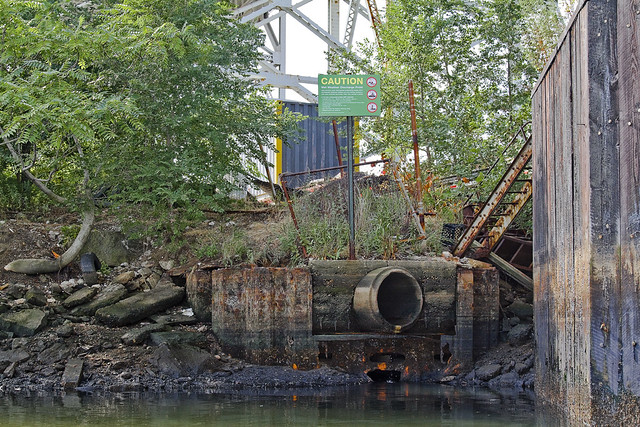
The first thing you see when passing the Borden Avenue Bridge is an archaic sewer outfall, and were the brush not at it’s mid summer height, one would observe the shanty home of the Blue Crow above.
For those of you not familiar with this term, Crow is a name assigned in my little section of Astoria to the myriad metal and refuse collectors known to haunt the neighborhood on “Bulk Pickup Day”. Leave something shiny on the sidewalk, a crow will sweep in and grab it.
Metals are collected and sold by the pound in the scrap and recycling markets of Greenpoint and Long Island City, and these guys make their living from hunting and gathering. I assign them color names based on vehicle, or clothing choices.
There’s also a red crow out there.

– photo by Mitch Waxman
Here is a winter shot from road grade level which shows the sewer and the ever expanding hut of this particular crow. There is a photo of him to be in this Newtown Pentacle posting from February of 2010. Don’t be mistaken, I am not insulting either his industriousness or tenacity, if I were in a similar situation things would go far worse for your humble narrator. This man has been surviving in what has to one of the world’s most extreme environments for years now, and rent free.

– photo by Mitch Waxman
Looking back toward the Borden Avenue Bridge, the ominous humming which echoed along the bulkheads and emanated from above signaled that we had passed under another of the bridges of Dutch Kills. This bridge was built high, and called an expressway by Robert Moses himself.

– photo by Mitch Waxman
Some 106 feet over road grade, the high flying Queens Midtown Expressway leg of the larger Long Island Expressway feeds into the yawning mouth of the Queens Midtown Tunnel less than a mile from here. I call this part of Dutch Kills DULIE, or Down Under the Long Island Expressway.
One of the common complaints heard by eastern bound commuters in the early days of the 20th century was about the horrible smells they encountered when crossing through Long Island City. Moses built his auto bridge as high as engineering and budgetary considerations allowed in response to the plume of industrial outgassing which distinguished a trip through the area in his time.

– photo by Mitch Waxman
Dutch Kills is a particularly important tributary of the Newtown Creek, from an industrial history point of view. What is today a relict of brown fields, industrial spills, and toxic leave behinds was once the economic and manufacturing heartland of New York City. The heavy infrastructure here is no accident, and the waterway was a critical feature that drew one of the great (and largely forgotten) men of Queens to the Waste Meadows at the start of the early 20th century.

– photo by Mitch Waxman
At the end of the 19th century, none of this was here. Sure, there was a muddy road made of creosoted wood blocks and riprap bulkheads called Hunters Point Avenue which ran between isolated industrial sites, and a slightly more modern causeway called Borden Avenue which hosted a few large operations, but this was a swampy and pestilential bog. Brackish creeks wound along knolls of marsh grass and the stubby trees held together mud islands.
The place was lousy with all the junk floating down from Blissville and the sewers in Brooklyn and only Mosquitos and ticks found the place hospitable.
Dutch Kills needed to be fixed.
– photo by Mitch Waxman
Another sewer outfall is found directly after passing the LIE’s massive footing, which is the sort of improvement that benefited somewhere else rather than Dutch Kills. It was decided by the city fathers in the first years of the 20th century that something had to be done with these swampy wetlands, so close to Manhattan and the gold coast of the Newtown Creek.
Something was needed- a plan with vision, executed by someone who understood the byzantine politics of Tammany Hall and the recently consolidated City of Greater New York. Additionally, it would have to someone with proven “know how” who could “get it done”.

– photo by Mitch Waxman
From the mid 1930’s on, that person would have been Robert Moses. The ultimate political fixer, Moses employed the greatest engineering minds of a generation to shape and design our modern City. While Moses was still in diapers, however, no shortage of great men existed in the City. A plan was presented, and approved, and in both Albany and Washington- strings were pulled by the Tammany men and budgets were approved.
The Army Corps of Engineers were assigned here to canalize, deepen, straighten and erect industrial bulkheads at Dutch Kills in 1914. Land was reclaimed by dumping the fill and spoils produced by the digging of the Belmont Subway Tunnels (leading to to Manhattan) amongst wooden pilings driven deeply into the mud.
The modern shoreline of Queens began to assume it’s current shape.

– photo by Mitch Waxman
It is apparent what happened here, when you see the Hunters Point Avenue Bridge appear before you.
Progress had arrived in Queens, and his name was Michael Degnon.


 The Newtown Pentacle