Posts Tagged ‘newtown creek’
formula filled
My creek also puts on a show when I’ve been away from her too long.
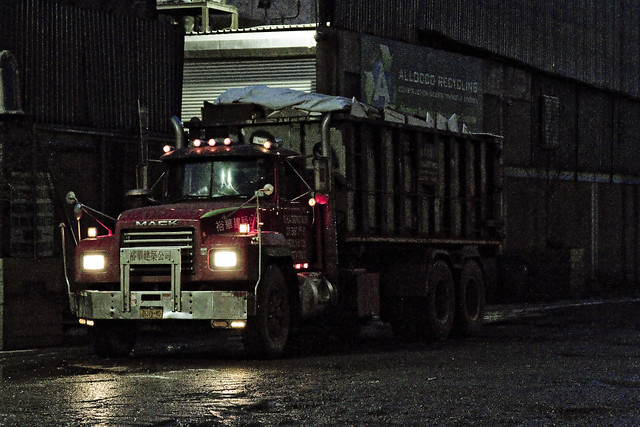
– photo by Mitch Waxman
One of my practices, developed over the last decade or so, is to take a Newtown Creek break periodically and “allow my liver to return to a normal size.” I’m joking about the liver, but one does enjoy a bit of detox occasionally, and allowing the poisons I’ve accrued a chance to leach out. This is a luxury one enjoys, as he doesn’t live along Newtown Creek, others aren’t so lucky. Pictured above is roll on/ roll off garbage truck carrying a bin, spotted at a waste transfer station owned by a friend of mine which fairly straddles the border of Brooklyn and Queens.
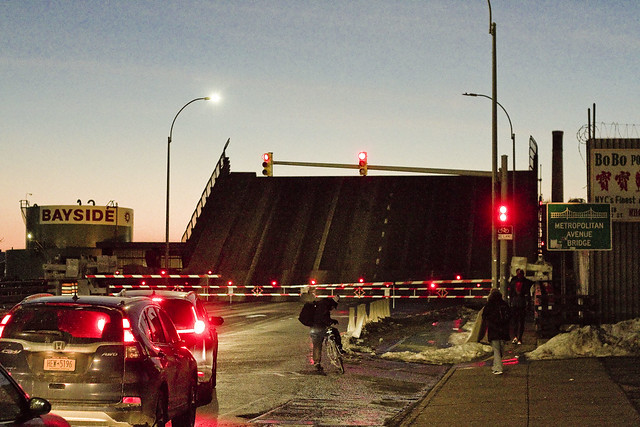
– photo by Mitch Waxman
Marching along Metropolitan Avenue, one squealed with delight as the Metropolitan Avenue Bridge began to open. This used to be quite a frequent occurrence “back in the day.” These days there’s only one regular maritime customer back here on the English Kills tributary, which is Bayside Fuel.

– photo by Mitch Waxman
The timing of the bridge opening was bizarre, occurring at precisely the time of one of the heaviest traffic intervals in this section of North Brooklyn, about 6:30 p.m.

– photo by Mitch Waxman
That odd timing, however, allowed one to stand in the middle of Metropolitan Avenue without getting squished.

– photo by Mitch Waxman
I believe that the tug pictured above is the Mary H., which normally handles the Bayside duty, but it’s hard to say as I didn’t get any of its markings. I did manage to focus in on the captain in his wheelhouse, however, so “win.”
As a note, the Metropolitan Avenue Bridge spans the English Kills tributary of the larger Newtown Creek at a navigational mark 3.4 miles eastwards of the East River. Metropolitan Avenue was originally created as a private toll road about 1814, and was called the Williamsburgh and Jamaica Turnpike. The owners of the toll road, and the original bridge, were two brothers whose family name was Masters. That’s why you’ll occasionally see references to the road as the “Masters Turnpike” and the “Masters Bridge” in the historical record, if like me, you stay up until 4 in the morning reading old municipal journals and reports from the Chambers of Commerce of Brooklyn or Queens.

– photo by Mitch Waxman
My conceit is to call this area of Newtown Creek surrounding the Metropolitan Avenue Bridge “DUMABO.” That’s short for “Down Under the Metropolitan Avenue Bridge,” as I believe we need to be ahead of the real estate people on these sorts of things.
“follow” me on Twitter- @newtownpentacle
ignorantly spared
Back on the job.

– photo by Mitch Waxman
Since the recent extreme cold spell has broken, a humble narrator has found himself marching about again, and boy are my dogs barking. On Tuesday, a stroll over to Bushwick East Williamsburg was enacted and the farthest reaches of the Newtown Creek at English Kills were observed. As expected, the waterway was frozen over.

– photo by Mitch Waxman
Toxic ice. You don’t get to say that particular phrase that too often, but that’s what you’re looking at in the shot above. English Kills is the far eastern terminus of Newtown Creek, which branches off of the East River nearly 3.8 miles from the larger waterbody. These shots were gathered at about 3.7 miles back.

– photo by Mitch Waxman
That big sewer outfall at the end of the tributary is the 3.8 mile terminus mark, and the north/south street seen beyond the fencelines is Johnson Avenue. The surrounding neighborhood is gentrifying (dictionary definition of gentrifying), but on a fairly small scale as compared to points found to the west like LIC and Greenpoint.

– photo by Mitch Waxman
One decided to hang around the neighborhood for a bit and stretch my legs after the long interval of being trapped in the house by inclement clime, and visit a few of my favorite places. This shot is from the Scott Avenue footbridge, which spans the LIRR’s Bushwick Branch freight tracks, just as the burning thermonuclear eye of God itself was dipping behind New Jersey to the west.

– photo by Mitch Waxman
Heading over towards Metropolitan Avenue, and another of the dead end tributaries of Newtown Creek – the East Branch, one discovered that this section of the water was similarly locked in a decidedly polar state.

– photo by Mitch Waxman
The ice was decaying faster in both waterways where it touched the open sewer outfalls, no doubt due to the flow of melt water laden with road salt coming in from as far away as Canarsie. This untreated sewage is quite biologically active as well, and the metabolism of the microscopic entities contained in the water column likely helps to warm it up a bit.
“follow” me on Twitter- @newtownpentacle
surviving entry
A good place to get dead, the Newtown Creek.

– photo by Mitch Waxman
Something I get asked about all the time is whether or not bodies get regularly dumped into Newtown Creek. My stock response is “only of its amateur hour.” If you’re dumping a body in NY Harbor, you want to make sure that it disappears quickly. Nothing that falls into Newtown Creek vanishes, it just sinks to the bottom and eventually it comes bubbling back up to the surface. The East River is crap for this duty as well. The Hudson, or Jamaica Bay, however…
Nevertheless, a lot of people have ended up dead in the Newtown Creek over the centuries.
Charles Hannigan, who once lived on fifth street in the Eastern District of Brooklyn, was fishing along and drowned in the Newtown Creek in early September of 1856. His body was never recovered. On August 1st of 1866, a 40 year old escapee from a lunatic asylum in Flatbush, named John Montayne, attempted suicide at Newtown Creek but was revived. In 1870, a dock worker named Patrick Boyle fell into Newtown Creek nearby Hunters Point and drowned, while three men watched and did nothing to help him. In September of 1874, a Long Island City Policeman, Officer Minnocks, found the body of an infant with a crushed skull floating in Newtown Creek. In February of 1878, Blissvillian William Owens fell out of a rowboat and drowned in Newtown Creek, his body was never recovered. In 1886, the body of S.W. Meyers, who had disappeared eight weeks prior in Manhattan, was found floating nearby the Penny Bridge along Newtown Creek.
Meyers was described as feeble, and given to fainting spells. It was presumed that he just fell into the water and drowned.

– photo by Mitch Waxman
Joel Rifkin, the serial killer, dumped a 55 gallon steel drum containing the corpse of a woman in May of 1992 in Newtown Creek, according to his 1995 confession. In 1996, a United States Army Captain named John Lau disposed of the bodies of a married couple, Alexander and Liane Barone, in the Newtown Creek not too far from the Metropolitan Avenue Bridge. A fellow named Derek Winefsky drove his car at high speed through the waterside fence line of Greenpoint’s Apollo Street in 2008, and whereas his body was recovered, that of his passenger disappeared into the murk. In October of 2017, a decomposing body was discovered at the very end of the English Kills tributary of Newtown Creek in Bushwick by one of my colleagues at Newtown Creek Alliance.
Basically, it’s pretty difficult and expensive to dispose of a human body, even under the best circumstances. Ever heard how much a funeral costs? Imagine trying to do it all quiet and secret like.

– photo by Mitch Waxman
A humble narrator has no first hand knowledge of the following, rather it’s the product of bar room banter with all sorts of old timey characters, disreputable rogues, and grifting undesirables in Long Island City and Greenpoint; back in the “old days” when the “boys” were still in charge around the Creek and one of their uncooperative business associate needed “getting rid of,” it wasn’t that difficult to find a local crematorium or industrial furnace tender whose palm was easily greased. Additionally, if the cover story you offer – regarding your employment – to both religious leaders and Federal prosecutors is that “you work in waste management,” ditching 150-250 pounds of meat into the waste flow isn’t that big a challenge.
So the short answer is “No, Virginia, people don’t dump bodies in Newtown Creek that often, and if they do they’re amateurs.”
“follow” me on Twitter- @newtownpentacle
immediately upon
It’s National Sacher Torte Day, in these United States.

– photo by Mitch Waxman
The concrete devastations of Newtown Creek, after the burning thermonuclear eye of God itself has slipped behind and become occluded by the state of New Jersey, are spooky. During daylight, they’re just a cautionary tale with occasional glimpses of terror and wonder, but after darkness settles in on the soot stained masonry offered by the warehouses, factories, and the Great Wall of Calvary Cemetery – one finds himself constantly looking over his shoulder. In the case of the furtive glance captured above, my apprehension was directed towards the spot where Review Avenue transmogrifies into Laurel Hill Blvd. nearby the old and nearly forgotten Penny Bridge. The masonry of the 1894 Penny Bridge is still extant, despite the actual span having been demolished around 1940. The first Penny Bridge, which was little more than a rope walk, opened thereabouts in 1803. It is at Penny Bridge that the presence of the spectral Blissville Banshee was first reported in 1884, as she glided across the oily waters of the Newtown Creek.
I mean – this ain’t Queens Plaza – where legions of vampires are known to drop from the steel rafters of the subways when night comes – but… Blissville after dark is just plain weird.

– photo by Mitch Waxman
It’s not just me who feels this way, either. Last Spring, a buddy of mine – who’s fairly fearless – was walking along this stretch with me at night. He began to ask insistently where we were, and opine that he was completely disoriented despite being in his native borough. Paranoid ideations began to blossom in his mind, and despite my insistence that we were on very familiar ground, anxiety began to overwhelm his reason. A distinct sigh of relief escaped his cranial breathing holes when we emerged onto Greenpoint Avenue after walking down shadow haunted Review Avenue in a generally northern direction.
Perhaps he was experiencing the sort of chronal tunnel vision that I often do.

– photo by Mitch Waxman
Could he have subconsciously known that Van Iderstine’s used to be here, or about Fleischmann’s Yeast with their stable of pneumoniac cattle. The unhealthy condition of these cattle, which attracted the attention of newspaper reporters, hygenicists, and State Board of Health Inspectors from Albany back in 1879, was attributed to being fed only fermented grain produced by the yeast brewers, which slid into their feeding troughs still steaming and straight from from the distillery process. The milk these cows produced was blueish in coloration, and nearly 1% alcohol by volume. This so called “swill milk” was not considered fit for general human consumption, as it was the lowest grade of dairy product commercially available in that era, but was considered a fitting protein source to serve to the orphans and prisoners confined on Blackwells Welfare Roosevelt Island. Nellie Bly might have spent ten days in a madhouse, but I don’t think she mentioned drinking swill milk in her famous exposé.
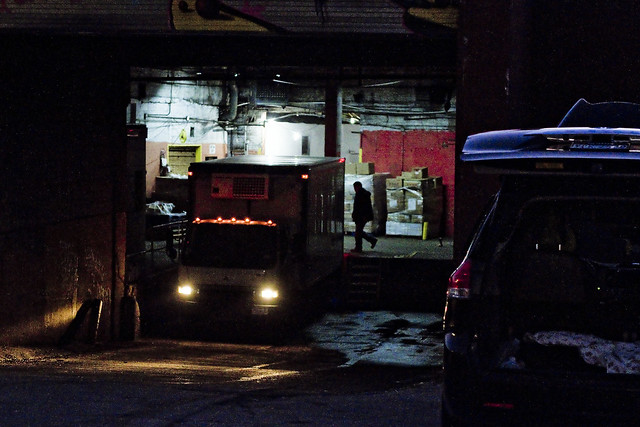
Van Iderstine’s, for those of you lucky enough to it have never heard of the business which used to inhabit these parts, ran a fat rendering mill hereabouts that was extant until the latter half of the 20th century. Animal parts, spoiled meat, rotten eggs, barrels of butchers blood – all were boiled down in open copper vessels here in Blissville in pursuance of the manufacture of tallow. Ghastly business, that.
– photo by Mitch Waxman
Despite the atmospheric temperatures being low enough to allow one the usage of his full armor – the filthy black raincoat and a stout hat coupled with durable clothing woven from ruggose fibers – one is always aware of his vulnerability and obsequiousness to malign elements of society due to conducting my excursions on foot. It would be a simple matter for one or two stout men to overpower one such as myself, known for his physical cowardice and nervous temperament.
Others with stronger constitution might venture into the shadows of rumor haunted Blissville, but a humble narrator chooses instead to acknowledge his lurking fear and remain naught but a passing outsider and scuttling stranger.
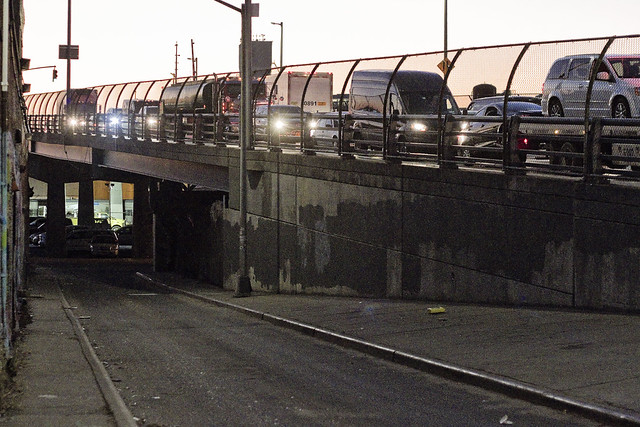
– photo by Mitch Waxman
Upon arriving at the inverse end of Review Avenue, a quick glance over my shoulder revealed a small group of stocky men forming up and pointing in my direction. They were clad in shadow, but the outlines of their group against the sodium lit walls of masonry revealed shapes which did not seem “right.” Discretion being the better part of valor, a humble narrator engaged the services of a passing taxi and made haste for the locked doors of HQ back in Astoria.
The world is a scary place, and the concrete devastations of Western Queens can be scarier than even the pathless deserts of Arabia, where the secrets of cities lost await discovery by the scientifically curious. What might be found… in those wisely abandoned metropolises… if occult rumors are to believed… could easily spark another dark age, and retard the forward progress of mankind – or possibly end civilization itself and condemn mankind to an endless era of ape like barbarity.
As far as the Blissville section of LIC goes – who can guess, all there is, that might be hidden down there?
Upcoming Tours and events
Calvary Cemetery Walking Tour, with Atlas Obscura – Sunday, December 10th, 11 a.m. – 1 p.m.
Explore NYC history, hidden inside sculptural monuments and mafioso grave sites, as you take in iconic city views on this walking tour, with Newtown Creek Alliance Historian Mitch Waxman – details here.
“follow” me on Twitter- @newtownpentacle
strange chemicals
It’s National Harvey Wallbanger Day, in these United States.

– photo by Mitch Waxman
My colleague at Newtown Creek Alliance, Will Elkins, does a formal survey of Newtown Creek and its tributaries about once a week from the vantage point offered by a small boat outfitted with an electrically driven motor. Will collects water samples which are sent off for laboratory analysis to ascertain bacterial levels in the water, and looks around at the shorelines for evidence of this or that. I do a less formal survey of the creeklands, which is performed on foot, and documented using a camera. Will is NCA’s Navy, which I guess makes me a Marine? I dunno, just some shmuck with a camera is all I’ve ever claimed to be.
Last week, a humble narrator was perambulating around Dutch Kills, in Long Island City.

– photo by Mitch Waxman
One thing I can tell you about LIC that’s seriously changed in the last decade is the presence of large groups of people. Ten years ago, this stretch of 29th street (which is technically not a city street, but rather a “railroad access road”) bordering the turning basin of the Dutch Kills tributary of Newtown Creek was absolutely deserted except for me and the folks who work in the surviving industrial buildings hereabouts. These days, 29th street has become the de facto spot for students from the various charter high schools, and LaGuardia community kids, who attend school nearby in the former “Degnon Terminal” to go “smoke a bowl.” There were about five or six distinct groups of them when these shots were being captured, whom were carefully not framed in to my shots.
Personally, I’ve got zero issues with people getting stoned on weed – I went to art school, after all, and grass smells a whole lot better to me than Dutch Kills does – but one is concerned ultimately about youthful inebriates ecstatically mucking around in an area known for its environmental degradation, lack of sidewalks, and heavy trucking.

– photo by Mitch Waxman
It was low tide when I was walking the bulkheads – and if I can say that I have a favorite sediment mound – the one pictured above is it. This shot, and the ones following, were captured from the Hunters Point Avenue Bridge.
For those of you not clued into the Newtown Creek story, the natural bottom of the waterway is anywhere from thirty to forty feet below the surface. A lack of “flow” and the presence of several large “combined sewer outfalls” has built up a bed of sediments which lie some 15-20 feet thick. These sediments – which are a layer cake of municpal horrors that include heavy industrial runoff, as well as everything that has ever been swept into the sewer grates of Brooklyn and Queens, are commonly referred to as “black mayonnaise.” The specific mission of the Federal EPA, regarding the Superfund situation, is to remove or remediate this sediment bed found in the waterway.
In certain places – especially along the “dead end” tributaries like Maspeth Creek, English Kills, and Dutch Kills – the black mayonnaise shoals up along the bulkheads and at low tide ends up becoming exposed to the air. Doesn’t matter how pungent the weed being smoked nearby is when these sediment mounds are upwind, they’re soon all that you can smell.

– photo by Mitch Waxman
When the angle of the burning thermonuclear eye of God itself is right, the water column is illuminated at Dutch Kills, which was canalized into a more or less north/south trajectory about a hundred years back. Prior to that, it was a compromised but still natural wetland environment with flood plains and swampy edges. Vital wetlands, we’d call ’em – back in the 19th and early 20th centuries they were called “Waste Meadows.”
Visible in the shot above are some of the queer jellies which form just under the surface along Dutch Kills’ bulkheads, which are likely bacterial or fungal mats suspended in the water.

– photo by Mitch Waxman
Along the western shoreline, enormous electrical cables emerge from the masonry of the Hunters Point Avenue Bridge, whose purpose is to power the single bascule drawbridge. I’ve seen Army Corps of Engineers reports stating that sampling of the shoal and sediment in Dutch Kills revealed the presence of Typhus, Cholera, and Gonnorhea extant in the mud down there. I haven’t seen that confirmed during the Superfund process, but there’s so much data about the biota of the Newtown Creek emerging that I could have missed it.
More sediment “mounding” is apparent, along with something fairly unexpected – evidence of “high” mammalian wild life.

– photo by Mitch Waxman
I’m a city boy, of course, but those tracks in the poisonous mud of Dutch Kills look like raccoon to me. I found a disembowelled raccoon on this span not too long ago, which is why I was thinking about the “trash pandas” while observing these paw prints, but again – City Boy.
For any of you “country kids” reading this, what would you say that track was left by?

– photo by Mitch Waxman
A curious new addition to the black mayonnaise was noticed on this particular walk around Dutch Kills, a series of terra cotta dishes or pots, some of which were adorned with an intricate pattern.
The question of “why would somebody make the effort to travel all the way to this odd corner of NYC just to discard terra cotta pots with intricate patterns into the waters of Dutch Kills, instead of just putting them out on the curb with the rest of their household garbage” must be discarded. There are things you just don’t want to know the answer to, and mystery in the age of Google is something to be preserved and embraced.

– photo by Mitch Waxman
Who can guess, all there is, that might be buried down there?
Upcoming Tours and events
Exploring Long Island City, from Luxury Waterfront to Abandoned Factories Walking Tour,
with NY Adventure Club – Sunday, November 12th, 2:30 p.m. – 4:30 p.m.
Long Island City is a tale of two cities; one filled with glittering water-front skyscrapers and manicured parks, and the other, a highly active ground transportation & distribution zone vital to the New York economy — which will prevail? With Newtown Creek Alliance Historian Mitch Waxman – details here.
Calvary Cemetery Walking Tour, with Atlas Obscura – Sunday, December 10th, 11 a.m. – 1 p.m.
Explore NYC history, hidden inside sculptural monuments and mafioso grave sites, as you take in iconic city views on this walking tour, with Newtown Creek Alliance Historian Mitch Waxman – details here.
“follow” me on Twitter- @newtownpentacle


 The Newtown Pentacle