Archive for the ‘Working Harbor Commitee’ Category
perpetually ajar

– photo by Mitch Waxman
Recent serendipity found your humble narrator onboard a vessel plying the languid waters of the Newtown Creek. This particular adventure was part of a larger and laudable effort which will be the subject of a posting later in the week, but urgent demands and unavoidable deadlines preclude discussion of the outing at this point. Instead, one is anxious to share the scenic wonders and hidden landscape of this water body that defines the currently undefended border of Brooklyn and Queens.
Captured in the heart of DUMABO (Down Under the Metropolitan Avenue Bridge), the shot above depicts the far off and omnipresent Sapphire Megalith rising over industrial Brooklyn and framed by the Metropolitan Avenue Bridge while opening at English Kill.

– photo by Mitch Waxman
The self same Megalith again provides geographic context for the scene, and the thrice damned Kosciuszko Bridge and Calvary Cemetery occupy the foreground.
To the right is the Phelps Dodge site, and to the left is found the lurking fear and that rampant darkness which lurks on the Brooklyn side of DUKBO (Down Under the Kosciuszko Bridge Onramp).

– photo by Mitch Waxman
In the shot above, gaze in wonder at the skyline of the Shining City itself, as framed by the titan National Grid tanks and the myriad works of infrastructure arrayed across the Brooklyn flood plain. Inextricably linked, the heavy industries and energy installations along the Newtown Creek allow the Shining City to maintain the facade of assumptions which Manhattanites prefer to believe about this place where aspirant and realist metaphors clash.
More, on why exactly I was on this boat, will be forthcoming. Apologies for brevity and obfuscation.
fulgent images

– photo by Mitch Waxman
This is not the world you know, this 3.8 mile long cataract of water which forms the currently undefended border of Brooklyn and Queens, whose mouth is found directly opposite the Bellevue Psychiatric Hospital in Manhattan. The very air you breathe is a poisonous fume, and beneath the languid ripples of its mirrored surface hide a morass of centuries old poisons which have been allowed to agglutinate and congeal in fuligin depths. This is where the industrial revolution actually happened, around the canalized bulkheads of the infamous Newtown Creek.

– photo by Mitch Waxman
Great fortunes have arisen here- the Pratts, and Rockefellers, even Peter Cooper- all grew fat at this banquet table. Five great cities arose around the Creek- Williamsburg, Long Island City, Greenpoint, Bushwick, and New York- and by 1900 a thriving maritime industry saw more cargo cross this tiny waterway than could be found on the entire Mississippi river. The vast populations of those five cities found employment here, in titan rail yards and factory mills whose smokestacks blotted out the light cascading down from the burning thermonuclear eye of god itself. This is where the bill came due in the early 20th century, as you cannot have a “Manhattan” without causing a “Newtown Creek”.

– photo by Mitch Waxman
Thought irredeemable, this place became a dumping ground, with raw sewage and every imaginable kind of filth allowed to pool and mingle with the water. By the end of the 20th century, it was a literal backwater and forgotten by all but those cursed to live nearby. Petroleum swirls about beneath the ground, mingling with the esoteric byproducts of early chemical factories and one and a half centuries of breakneck industrial growth. The top soil is impregnated by heavy metals, asbestos, and tons of soot deposited daily by automotive exhaust. Along the rotting bulkheads, sediment mounds of sewage rise from the water, and from forgotten pipelines unknown chemical combinations drip and drool. Who can guess, all there is, that might be buried down there?

– photo by Mitch Waxman
Hope rises, however, at the start of the Superfund era. Federal authorities have begun the laborious process of analyzing and categorizing those sediments which lie fifteen to twenty feet thick on the bottom of the waterway, colloquially referred to as “Black Mayonnaise”. The Superfund legislation which governs their actions has compelled them to remove and remediate these sediments, and deliver Newtown Creek to the future in a healthier condition. Community groups, industrial stakeholders, and officials from both the State and City have begun the task of planning the Newtown Creek of future times. This is the literal backbone and center of New York City.
rarest flowers
A number of “Things to do” have materialized of late, so it is time for your Newtown Pentacle calendar of April events and/or fun things to do.

– photo by Mitch Waxman
There are a whole lot of things in the planning phases which I can’t tell you about yet, but suffice to say that this should be an amazing summer. Diversions on land and water will soon be announced, including boat tours of Newtown Creek and the greater harbor beyond.

– photo by Mitch Waxman
First up, today there will be a protest in Manhattan concerning recent City plans- via newtowncreekalliance.org
Rally to oppose Thermal “Waste-to-Energy” Facilities
April 9th, 2012
On Monday, April 9th at 10am, environmental justice groups, environmental organizations, community leaders and elected officials from Brooklyn, the Bronx and Manhattan will rally to oppose the Bloomberg administration’s plan for thermal “Waste-to-Energy” facilities (a.k.a. incinerators). Two of the proposed sites for this facility are on the shores of Newtown Creek, and our communities host 40% of the city’s waste transfer facilities, so we are adding our voice to the cause. Click here for our previous post on the issue, and download two fact sheets on Waste-to-Energy here and here.

– photo by Mitch Waxman
Secondly, from workingharbor.com
All About Tugs—Inside the Tugboat Industry
Tuesday, April 17 at 6.p.m.
Special evening program will feature documentary films with commentary by tug captains and crew presenting an insider’s look at the tugboat industry—its colorful history, present-day work, and vital importance.
Community Church of New York, 40 East 35th Street, Manhattan
Tickets are $25 ($20 for seniors). They can be purchased at www.workingharbor.com and include a reception with food, beer, wine and other beverages.
New York, NY, April 2, 2012 — Everybody loves tugboats, those iconic little workhorses that push ships ten times their size through narrow waterways and tow barges laden with fuel oil through busy harbors. “It is like the “Little Engine That Could,” or the mouse that pulled the thorn out of the lion’s paw,” said filmmaker Tom Garber, whose documentary, Tugging Through Time: The History of New York Harbor Tugboats, will be featured, The Working Harbor Committee (WHC), a not-for-profit organization dedicated to educating the public about the history and present-day importance of the Port of New York and New Jersey, is sponsoring the presentation. Since 2002 WHC has taken more than 20,000 people on Hidden Harbor® boat tours to visit behind-the-scenes waterfront places that most people never get the chance to see. “Tugboats are always the biggest hit,” said Captain John Doswell, the organization’s executive director. WHC also runs the annual New York Harbor Tugboat Race. “People always ask what it is like to be on board. Our ‘All About Tugs’ program will answer that question.”

– photo by Mitch Waxman
Third, also from newtowncreekalliance.org
Earth Day BYO Picnic Lunch at the Newtown Creek Nature Walk
Sunday, April 22nd at 1 p.m.
Come join in for this casual celebration of the victory that is the Newtown Creek Nature Walk. Bring your own brown bag lunch and join the Newtown Creek champions who worked hard for years to win this unique waterfront park.
Sunday, April 22nd at the Newtown Creek Wastewater Treatment Plant Nature Walk between 1pm – 2pm.

– photo by Mitch Waxman
Fourth, another NCA event, which I for one am pretty stoked about:
April NCA meeting hosts Dr. Eric Sanderson
April 26, 2012 at 6pm
Ridgewood Democratic Club, 6070 Putnam Avenue, Ridgewood, NY 11385
In addition to important updates from our members – in particular the Bioremedition Workgroup has been very busy! – we will be hosting a special presentation on the “Historical Ecology of Newtown Creek”.
Dr. Eric Sanderson, senior conservation ecologist at the Wildlife Conservation Society and author of “Mannahatta: A Natural History of New York City” (Abrams, 2009), will describe recent studies of the historical ecology of Newtown Creek, describing the original wetlands, creek channels, topography and vegetation of the area. He will show a series of 18th and 19th century maps of the watershed of the creek and discuss the process of synthesizing them into an integrated ecological picture that can be used to inform and inspire natural restoration and cultural appreciation of the Newtown Creek watershed. This work is part of the Welikia Project (welikia.org), an investigation into the historical ecology of the five boroughs of New York City and surrounding waters.
Finally,

Obscura Day 2012, Thirteen Steps around Dutch Kills
April 28th, 10 a.m.
Your humble narrator will be narrating humbly at this year’s Obscura Day event on April 28th, leading a walking tour of Dutch Kills. The tour is already half booked up, and as I’m just announcing it, grab your tickets while you can.
“Found less than one mile from the East River, Dutch Kills is home to four movable (and one fixed span) bridges, including one of only two retractible bridges remaining in New York City. Dutch Kills is considered to be the central artery of industrial Long Island City and is ringed with enormous factory buildings, titan rail yards — it’s where the industrial revolution actually happened. Bring your camera, as the tour will be revealing an incredible landscape along this section of the troubled Newtown Creek Watershed.”
For tickets and full details, click here :
obscuraday.com/events/thirteen-steps-dutch-kills-newtown-creek-exploration
garret studio

– photo by Mitch Waxman
There’s a whole lot of dredging going on.
It seems that the Harbor of NY itself is desirous of silting up, which would destroy its value as a commercial port. What the Harbor is actually doing is attempting to revert to the shallow estuary it once was, following the methodologies set down by nature, but this would impede navigation and be catastrophic for both the economic and urban activities of man.
When the terrorist is nature incarnate- the Marines, Army, or Air Force can’t help you at all. Forget about Homeland Security, for any problem that involves a whole lot of dredging you send in the United States Army Corps of Engineers!
from nan.usace.army.mil
New York Harbor encompasses approximately two-dozen separately authorized and maintained Federal navigation channels. These projects, whose authorized depths vary from 8 feet to 50 feet, along with the privately operated berthing areas, generate approximately 1 to 2 million cubic yards of sedimentary material annually from maintenance dredging alone. Further, several of these channels are either under construction or in plans for deepening in the upcoming years to accommodate larger vessels calling at the port. The construction of these deeper channels will also generate substantial amounts of dredged material. The DMMP process seeks to identify and implement options to manage the material generated from both the federal and non-federal maintenance and deepening of the Port through the year 2065.

– photo by Mitch Waxman
The USACE has over the course of time reshaped the course of mighty rivers, eradicated tall mountains, and they’ve even bent the Helegaat to its will. The USACE has powers and abilities far beyond those of ordinary men, which they employ in a neverending battle for the American Way. In the case of the modern dredging observed around the Kill Van Kull and Port Newark, the Corps are ensuring that the soft bottom of the waterway will be deep enough to allow an enormous class of cargo ship called “Panamax” to safely navigate the port.
This involves the movement and dispersal of a whole lot of dredging spoils.
from nytimes.com
For more than a decade, workers using giant digging machines have scooped up enormous mounds of rock, clay, sand and silt from the waters around New York to deepen the shipping channels to accommodate giant cargo vessels that will navigate the widened Panama Canal starting in the middle of the decade.
The dredging has produced millions of cubic yards of muck.

– photo by Mitch Waxman
There’s a few different machines which are involved in this sort of thing, and not just the claw bucket derricks which are filling barges in these shots. Lots of private contractors actually do the work, with a few key players getting the lion’s share.
Some effort has been made to find shots of these various devices- photos which a humble narrator clearly remembers shooting- but they are currently lost amongst the nearly 20,000 shots which I’ve obtained and uploaded for usage at Newtown Pentacle in the last few years.
As far as my hard drives go, there’s a whole lot of dredging that needs to be done.
from epa.gov
The Administrator of the EPA and the Secretaries of the Army and of Transportation agreed to close the Mud Dump Site for disposal of dredged material in their 1996 Three Party Letter. This was in response to surveys that had shown that contaminants in the dredged material caused sediment toxicity and bioaccumulation effects in estuarine organisms. For example, worm tissue at the disposal site was found to accumulate dioxins, and both dioxin and polychlorinated biphenyl (PCB) contamination was found in lobsters. Individual elements of the aforementioned data do not prove that sediments within the HARS are imminent hazards to the New York Bight Apex ecosystem, living resources or human health. However, the collective evidence presents cause for concern, and justifies the finding that a need for remediation exists, that the site is Impact Category I (see, 40 CFR 228.10), and that the site should be managed to reduce impacts to acceptable levels.

– photo by Mitch Waxman
There’s little controversy around the idea that the government needs to keep these channels open, and lots of acrimony about what to do with the often toxic materials which are brought up to the surface. According to most sources, the sediment which rests on the floor of the harbor contains a cocktail of industrial leave behinds. Concerns are also voiced about sediments which reenters the water column and proceeds to swirl and shoal in new places.
Which brings us back to “What do you do with a whole lot of dredging spoils?”.
from nan.usace.army.mil
To accommodate the increasing need for the disposal of the assorted material, The Office of Supervisor of New York Harbor was established by an act of Congress in 1888. The Harbor Supervisor, acting through the Office of the Chief of Engineers (of the U.S. Army Corps of Engineers), was responsible for the designation of specific disposal sites and for ensuring that ocean disposal would not be detrimental to navigation or pollute adjacent beaches (Williams and Duane, 1974).
Materials including garbage, city refuse, cellar dirt (natural rock and soil excavated during building construction), floatable materials, and sediments derived from dredging during the maintenance, deepening and construction of new channels in New York Harbor, were dumped at specific locations in the New York Bight Apex. Records indicate that approximately six locations were selected to receive this wide range of materials. As the material accumulated at these locations, the sites were relocated farther seaward where increased water depths alleviated concerns of potential navigation threats posed by accumulation of materials.
Hydrographic data spanning the period from 1845 to 1934 revealed that mounds of material were being formed in the general area of the submerged Hudson Shelf Valley (Christiaensen Basin), the Ambrose Light Station (Diamond Hill), and the Scotland Light Buoy. By 1914, shoaling at one of the sites reserved for dredged material and cellar dirt became a critical factor in the decision of the Supervisor of New York Harbor to separate the site usages and thus segregate the material being disposed at each site.

– photo by Mitch Waxman
Were there just some seemingly limitless abyss, an infinity of dark and cold which might just swallow up the sins of the world. Indigo, this ideal dump would boast colossal pressure and unimaginable cold whose combination might vouchsafe whatever poisons you might secret away against future discovery. Some sunken Grand Canyon, which might be neither too far, nor too close.
This would be a great place, a historic one, to dispose of a whole lot of dredging spoils.
from wikipedia
The Hudson Canyon is a submarine canyon that begins from the shallow outlet of the estuary at the mouth of the Hudson River. It extends out over 400 nmi (740 km) seaward across the continental shelf finally connecting to the deep ocean basin at a depth of 3 to 4 km below sea level. It begins as a natural channel of several kilometers width, starting as a 20-40 m depression at Hudson Channel southward from Ambrose Light, then carving through a deep notch of about 1 km depth in the shelf break, and running down the continental rise. Tidally associated flows of about 30 cm/s (1 km/h) up and down the deeper parts of the canyon have been recorded. As silt, sand and mud are carried down the Hudson River, they flow into the canyon and out into the deep sea.
The Hudson Canyon proper is located about 100 miles (160 km) east of the mouth of the Hudson River off the New Jersey coast. Its walls rise three-quarters of a mile from the canyon floor making it comparable to the Grand Canyon, whose cliffs are over a mile deep and 270 miles (430 km) long. It is the largest known ocean canyon off the East Coast of the United States, and one of the largest submarine canyons in the world. The canyon is located near the 100 meter isobath on the continental shelf and is 2,200 m (7,217 ft) deep at the base of the continental slope. Over an 80 km (50 mi) distance, the average slope of the canyon floor is 1.5°. At this point the canyon is as much as 12 km (7.5 mi) wide (from east rim to west rim) and as much as 1,100 m (3,609 ft) deep from canyon rim to canyon floor across the continental slope. The floor of the canyon is less than 0.5 km (1,640 ft) wide across the upper part of the slope and broadens to about 0.9 km (~3,000 feet) at the base of the slope.

– photo by Mitch Waxman
The deeps have been explored a bit, but not enough, by the federal agency NOAA. They report that the canyon is littered with sunken sailing ships, indian canoes, even ocean going diesel freighters of relatively recent vintage. Can you imagine, all there is, that might be down there?
from pubs.usgs.gov
The 150-km-long Hudson Shelf Valley, the largest physiographic feature on the mid-Atlantic continental shelf, bisects the New York Bight region. The Valley is the submerged seaward extension of the ancestral Hudson River drainage system that, unlike other valleys on the Atlantic shelf, has not been filled with sediment. A survey of the topography and backscatter intensity of the valley has been carried out using a Simrad Subsea EM 1000 multibeam sea floor mapping system. The valley head is located in a broad shallow basin and extends offshore 5-40 m below the shelf surface to a seaward terminus at a shelf-edge delta. The valley can be divided into upper, middle, lower and outer sections based on the topography, surficial sediments, and drainage pattern. The middle valley is characterized by 5 local topographic lows along the valley axis that have relief of 3-11 m below the valley floor. The northwestern portion of the study area has been affected by disposal of dredged and other materials since the late 1800’s. Part of this area has been designated as the Historic Area Remediation Site (HARS). The sea floor of the HARS is being remediated by placing at least a one-meter cap of clean dredged material on top of the existing surface sediments that exhibit varying degrees of degradation. A large field of sand waves is located in the lower valley in 70-80 m water depth that cover an area approximately 30 km long and 4 km wide. This sand wave field is hypothesized to be part of a flood deposit that formed as a result of the break-out of glacial lakes in upstate New York approximately 13,500 years BP. In the eastern-most part of the survey area in water depths greater than about 110 m, the sea floor is marked by long narrow northeast-southwest-trending grooves that are interpreted to be iceberg scour marks.
ALSO:
March 5th, as in Monday night:
Riverkeeper and NCA ask: How’s the Water? How’s Newtown Creek?
Join Riverkeeper and the Newtown Creek Alliance for a presentation on water quality in the Hudson River Estuary and its tributaries, focusing on the waters around Manhattan Island and in Brooklyn’s Gowanus Canal and Newtown Creek.
March 5, 2012, 7:30PM to 9:30PM
Brooklyn Brewery, 79 North 11th Street, NY map
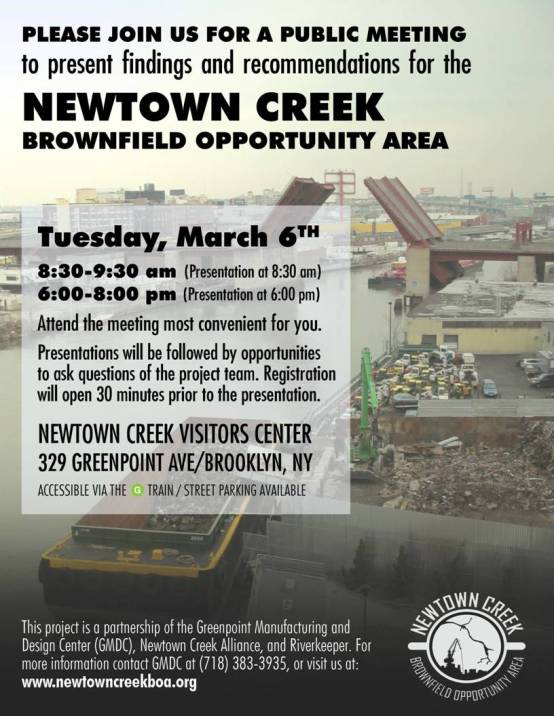
and March 6th, as in Tuesday
Magic Lantern Show in Ridgewood

Your humble narrator will be narrating humbly on Friday, February 24th at 7:30 P.M. for the “Ridgewood Democratic Club, 60-70 Putnam Avenue, Ridgewood, NY 11385” as the “Newtown Creek Magic Lantern Show” is presented to their esteemed group. The club hosts a public meeting, with guests and neighbors welcome, and say that refreshments will be served.
The “Magic Lantern Show” is actually a slideshow, packed with informative text and graphics, wherein we approach and explore the entire Newtown Creek. Every tributary, bridge, and significant spot are examined and illustrated with photography. This virtual tour will be augmented by personal observation and recollection by yours truly, with a question and answer period following.
For those of you who might have seen it last year, the presentation has been streamlined, augmented with new views, and updated with some of the emerging stories about Newtown Creek which have been exclusively reported on at this- your Newtown Pentacle.
For more information, please contact me here.


 The Newtown Pentacle