Archive for the ‘DUGABO’ Category
tireless and continuing
“follow” me on Twitter at @newtownpentacle

– photo by Mitch Waxman
Missives regarding the Newtown Creek reach my desk all the time, mostly describing activist causes and far reaching governmental plans, but a particular message from the United States Coast Guard seemed to be the sort of thing which will likely affect the communities (on both sides and upon the water) which are nearby the troubled waterway so I decided to share it with you.
The Greenpoint Avenue Bridge is going to receiving attention, this summer, from NYC DOT bridge painting crews.
from federalregister.gov
The Commander, First Coast Guard District, has issued a temporary deviation from the regulation governing the operation of the Greenpoint Avenue Bridge across Newtown Creek, mile 1.3, at New York City, New York. The deviation is necessary to facilitate bridge painting operations. Under this temporary deviation, the bridge may remain in the closed position for various times up to six days at a time during a four month period.

– photo by Mitch Waxman
From the sound of it, the main inconvenience will be felt by the maritime community, as the bridge repair will render the drawbridge static for as long as six days at a pop between May and September.
For drivers, and this is an incredibly busy span, one suspects that there will be traffic tie ups and lane closures but this is conjecture based solely on the behavioral and occupational patterns exhibited and displayed by DOT crews and their contractors on other projects around the City.
One suspects that the four day windows when the draw bridge is open for “business as usual” shall also witness a higher than normal number of bridge openings, which is good for me, of course as lots and lots of tugboats will be lined up along the Creek.
also from federalregister.gov
The bridge owner, New York City Department of Transportation, requested multiple six day closure periods between May 1, 2013 and September 30, 2013, to facilitate bridge painting operation at the Greenpoint Avenue Bridge. Each six day closure period will be followed with four days of normal bridge operations. The exact time and dates of each six day closure period will be announced in the Local Notice to Mariners and also with a Broadcast Notice to Mariners at least two weeks in advance of each closure period. This temporary deviation will be in effect from May 1, 2013 through September 30, 2013.

– photo by Mitch Waxman
C’est la vie, life in the big city, and what can you do about it anyway?
Such maintenance is a necessary inconvenience to keep the structure from rotting away into a corroded heap. The waters of the Newtown Creek, just like the East River, are brackish. Salt is the natural enemy of steel and no one wishes to see a traffic mess like the one created by the 1987 rebuild of the bridge occur anytime soon.
Additionally, although I imagine that the Public Art Commission will approve the continued usage of “Aluminum Green” paints for the Greenpoint Avenue Bridge, I would suggest that using “Pulaski Red” all the way back to the Metropolitan Avenue Bridge would visually unite and “Brand” the Bridges of Newtown Creek.
from nyc.gov
The first bridge on this site, a drawbridge known as the Blissville, was built in the 1850’s. It was succeeded by three other bridges before a new one was completed in March 1900 at a cost of $58,519. That bridge received extensive repairs after a fire in 1919 damaged parts of the center pier fender, the southerly abutment, and the superstructure. Until that time, the bridge had also carried tracks of the Long Island Rail Road. The current bridge was built in 1987.
Also: Upcoming Tours!
13 Steps around Dutch Kills– Saturday, May 4, 2013
Newtown Creek walking tour with Mitch Waxman and Atlas Obscura, tickets now on sale.
Parks and Petroleum- Sunday, May 12, 2013
Newtown Creek walking tour with Mitch Waxman and Newtown Creek Alliance, tickets now on sale.
The Insalubrious Valley- Saturday, May 25, 2013
Newtown Creek walking tour with Mitch Waxman and Atlas Obscura, tickets on sale soon.
Hidden Harbor: Newtown Creek tour with Mitch Waxman – Sunday, May 26,2013
Boat tour presented by the Working Harbor Committee,
Limited seating available, order advance tickets now. Group rates available.
crawl circuitously
“follow” me on Twitter at @newtownpentacle

– photo by Mitch Waxman
Just last week, as a dramatic downpour doused New York City, your humble narrator was at a Newtown Creek Monitoring Committee meeting at the Newtown Creek Wastewater Treatment Plant in Greenpoint debating the finer points of some signage which the DEP wants to hang on their fence line at the plant and for which they were seeking community input. When the clouds burst, however, and rain began to lash at the windows- one grabbed for the camera and headed to the door. If you’re at the largest sewer plant in New York City during a cloudburst, you take some pictures.

– photo by Mitch Waxman
A quarter inch of rain, citywide, becomes a raging river of one billion gallons surging through the combined sewer system. Combined sewers, a term indicating that storm and sanitary sewers share the same pipes, are one of the City’s “original sins.” This billion gallon per quarter inch torrent has no where to go except for sewers, which when added to the regular sewage flow, “outfalls” into those waterways which distinguish and define our little archipelago.

– photo by Mitch Waxman
The system of waste water treatment plants which are maintained by the DEP can handle some of this flow, using ingenious systems of weirs and diversion tunnels to slow down and store it for treatment, but a lot of the water hurtling through their network of sometimes centuries old pipe ends up going directly into the environment untreated. This is the problem which most afflicts my beloved Newtown Creek, but its also a big part of what’s wrong with the East and Hudson Rivers as well as all the smaller waterways found all around the harbor. This is also the reason why advisories are issued not to swim at area beaches following a storm.

– photo by Mitch Waxman
Unfortunately, there’s little that can be practically done about it. If we who are taxed asked those who are elected to spend our money to remedy the situation, the astronomical bill incurred would bankrupt the Municipal, State, and quite possibly the Federal governments. It would involve opening up every street in New York City, remapping the gravity driven sewer system which has grown in spurts over the last 300 years, and begin building a brand new dual system. This would be catastrophically expensive, disruptive to every facet of the community, and take decades.

– photo by Mitch Waxman
A simple thing each of us can do, based on an old adage- don’t waste a gallon of water on a pint of piss- is simply to not flush the toilet unnecessarily when its raining. By not adding your “constituents” to the flow during rain events, and I mean number one not two, you can help alleviate a significant amount of stress on the system and ensure that sewage does not wash out into the harbor with the storm water. This may seem “gross,” but here’s the question- can you tolerate leaving a bit of urine in the toilet for an hour or two until it stops raining or would you rather swim or boat in your own piss tomorrow?
Also: Upcoming Tours!
Glittering Realms– Saturday, April 20, 2013
Newtown Creek walking tour with Mitch Waxman and Atlas Obscura, tickets now on sale.
13 Steps around Dutch Kills– Saturday, May 4, 2013
Newtown Creek walking tour with Mitch Waxman and Atlas Obscura, tickets now on sale.
Parks and Petroleum- Sunday, May 12, 2013
Newtown Creek walking tour with Mitch Waxman and Newtown Creek Alliance, tickets on sale soon.
The Insalubrious Valley- Saturday, May 25, 2013
Newtown Creek walking tour with Mitch Waxman and Atlas Obscura, tickets on sale soon.
Hidden Harbor: Newtown Creek tour with Mitch Waxman – Sunday, May 26,2013
Boat tour presented by the Working Harbor Committee,
Limited seating available, order advance tickets now. Group rates available.
The 2013 Spring and Summer Tours Schedule
“follow” me on Twitter at @newtownpentacle

– photo by Mai Armstrong
Want to see something cool?
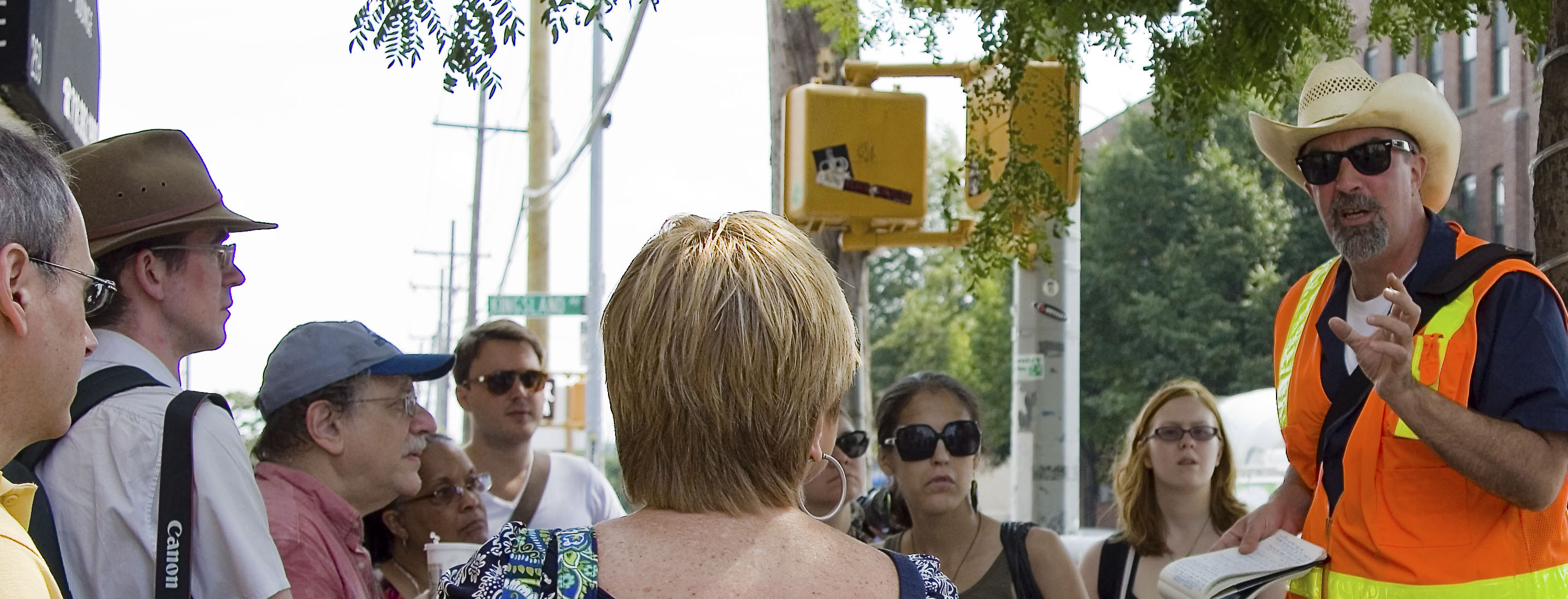
Odds are that a bunch of the folks who will be reading this might have no idea who Mitch Waxman is, why they should come along with him on a tour of some weird neighborhood in Brooklyn or Queens or Staten Island, nor what a Newtown Creek or Kill Van Kull are- let alone where. Who is this weirdo?
Check out the “bio” page here at Newtown Pentacle, or this profile of me from the NY Times published in 2012. My tours of Newtown Creek have garnered no small amount of interest from the fourth estate- whether it be DNAInfo, untappedcities.com, Queens Chronicle, newyorkview.net, the 22blog, photobycateblog.com, or Queensnyc, and I’ve turned up in a bunch of media reports, documentaries, and been interviewed for multitudinous reports on the lamentable history of the Newtown Creek.
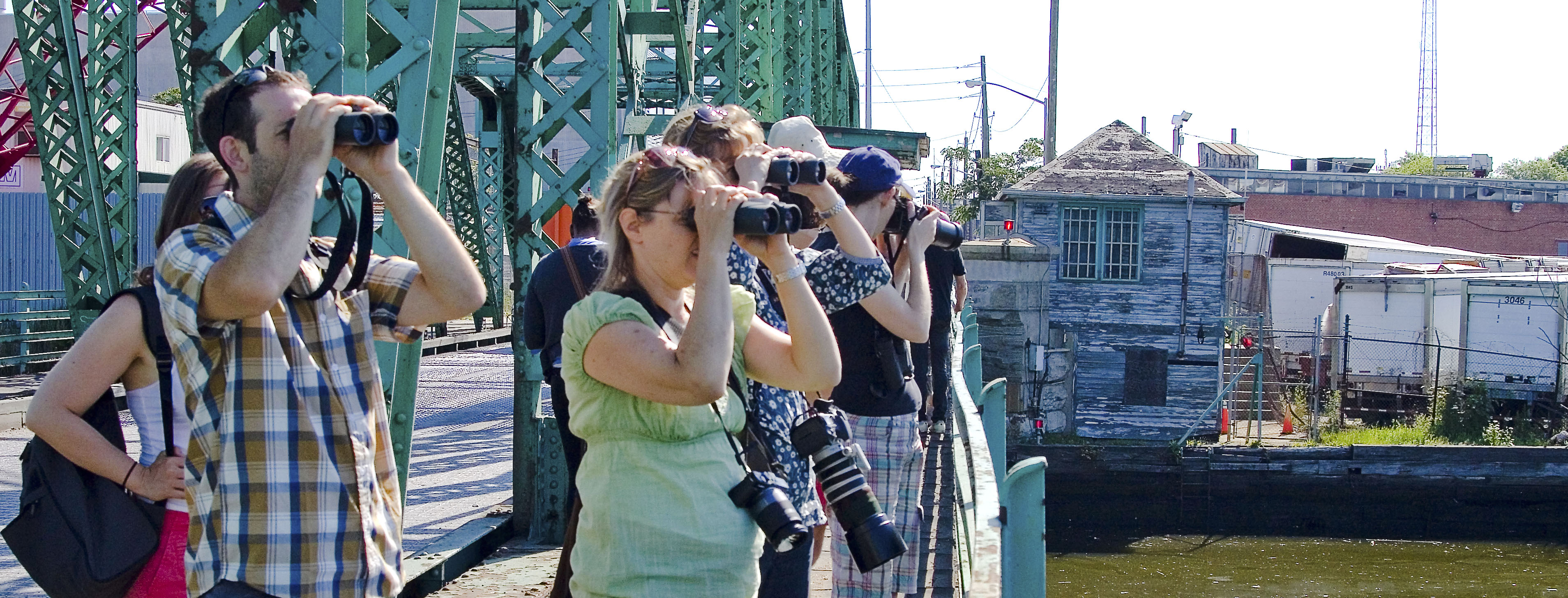
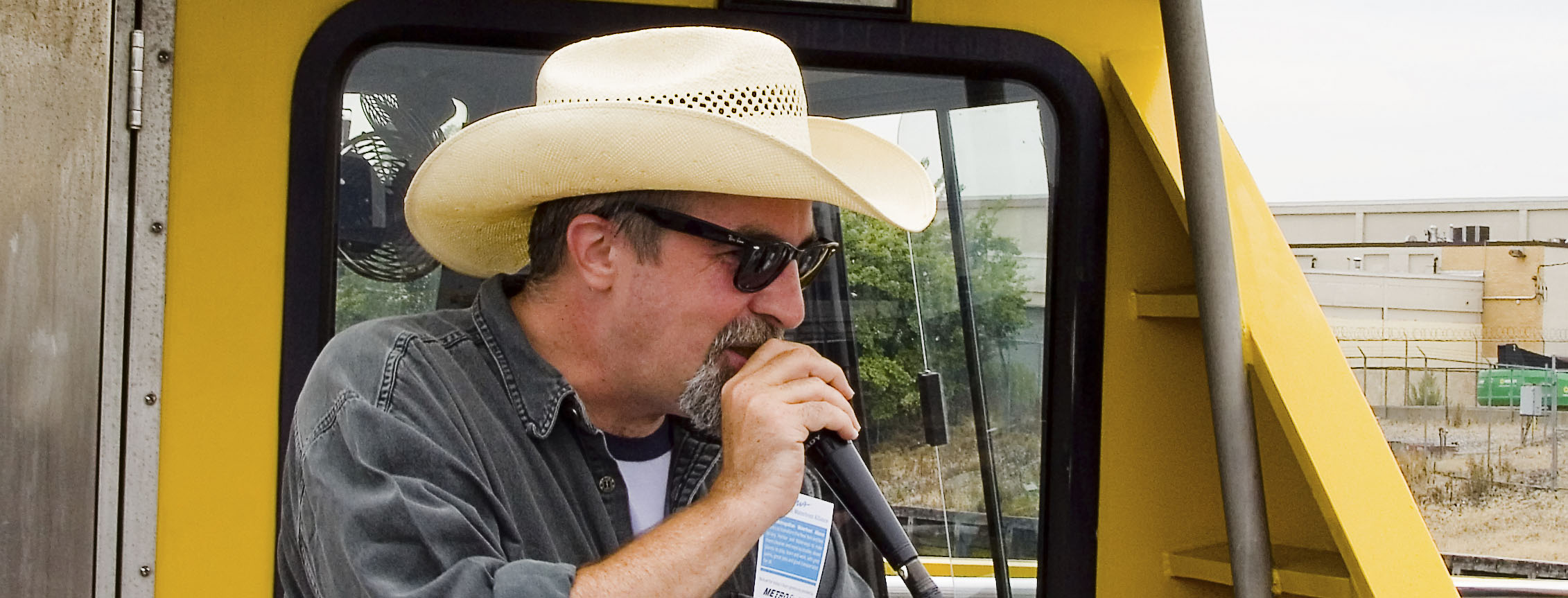
Most recently, it was National Geographic and Curbed. Attendees on my tours come from a variety of backgrounds- photographers, history and rail buffs, maritime enthusiasts, and there always seems to be an odd and welcome concentration of elected officials and journalists about.
What is with this guy?
I’m the Newtown Creek Alliance Historian, Official Photographer and Steering Committee member of the Working Harbor Committee, a member of the Newtown Creek Monitoring Committee and the Newtown Creek CAG, and am also a member of the Kosciuszko Bridge Stakeholders Advisory Committee. Newtown Pentacle, this blog, has been steadily published since 2009. I live in Astoria, Queens with my wife and our little dog, Zuzu.
In just the last few years, I have exposed thousands of people to the Newtown Creek, and its incredible history. This is where the industrial revolution actually happened, along this 3.8 mile long waterway that defines the border of Brooklyn and Queens.
– photo by Mai Armstrong
In 2013, continuing relationships with Atlas Obscura, Newtown Creek Alliance, and the Working Harbor Committee (as well as friends like the Metropolitan Waterfront Alliance, and others) allow me to offer the following schedule. Live ticketing links will be made available as they come online, and all dates are subject to cancellation or rescheduling due to weather or unforeseen circumstance. There are 6 unique walking tours listed here, and one boat trip in which I will be the principal speaker.
Private tours are possible, schedule permitting, and can be arranged by contacting me here. Last year, for instance, several private University classes engaged me for a day at the Creek, as did a few private groups. As mentioned, contact me and we will figure something out if you’ve got a meetup group, college class, or special request.
Here then, is my official schedule as it stands right now. There will likely be a few additions as time goes on, which I will let you know about as they occur. Best to subscribe to this blog (top right, email subscription) or “follow” me on Twitter @newtownpentacle for news.
In April, 2013- There will be a brand new tour of Greenpoint debuted, which I call “Glittering Realms.”
Glittering Realms– Saturday, April 20, 2013
Newtown Creek walking tour with Mitch Waxman and Atlas Obscura, tickets now on sale.
In May, 2013- We start off with 13 Steps around Dutch Kills, go to the Insalubrious Valley, visit DUKBO, and finish off the month with a Working Harbor boat tour.
13 Steps around Dutch Kills– Saturday, May 4, 2013
Newtown Creek walking tour with Mitch Waxman and Atlas Obscura, tickets now on sale.
Parks and Petroleum- Sunday, May 12, 2013
Newtown Creek walking tour with Mitch Waxman and Newtown Creek Alliance, tickets on sale soon.
The Insalubrious Valley- Saturday, May 25, 2013
Newtown Creek walking tour with Mitch Waxman and Atlas Obscura, tickets on sale soon.
Hidden Harbor: Newtown Creek tour with Mitch Waxman – Sunday, May 26,2013
Boat tour presented by the Working Harbor Committee,
Limited seating available, order advance tickets now. Group rates available.
– photo by Mai Armstrong
In June, 2013- We visit the Poison Cauldron, return to the Insalubrious Valley, and check out the Kill Van Kull.
The Poison Cauldron- Saturday, June 15, 2013
Newtown Creek walking tour with Mitch Waxman and Atlas Obscura, tickets on sale soon.
Kill Van Kull- Saturday, June 22, 2013
Staten Island walking tour with Mitch Waxman and Working Harbor Committee, tickets on sale soon.
The Insalubrious Valley- Saturday, June 29, 2013
Newtown Creek walking tour with Mitch Waxman and Newtown Creek Alliance, tickets on sale soon.
In July, 2013- We visit Queens’s Hunters Point with a brand new tour. I might have another offering or two for you, but nothing I can speak about quite yet.
Modern Corridor- Saturday, July 13, 2013
Newtown Creek walking tour with Mitch Waxman and Atlas Obscura, tickets on sale soon.
– photo by Mai Armstrong
In August, 2013- We return to the Poison Cauldron, repeat the 13 steps, and the Kill Van Kull walks.
Kill Van Kull- Saturday, August 10, 2013
Staten Island walking tour with Mitch Waxman and Working Harbor Committee, tickets on sale soon.
13 Steps around Dutch Kills- Saturday, August 17, 2013
Newtown Creek walking tour with Mitch Waxman and Newtown Creek Alliance, tickets on sale soon.
The Poison Cauldron- Saturday, August 24, 2013
Newtown Creek walking tour with Mitch Waxman and Atlas Obscura, tickets on sale soon.
There are a few other dates coming in the fall, and a couple of more summer events which are still being discussed, but I’ll let you know more about them in coming posts.
Also, I will definitely be onboard but not on the microphone during the Working Harbor Committee “Beyond Sandy” Hidden Harbor tours on Tuesday nights, all summer. Hope you can come along.
decreasing wind
“follow” me on Twitter at @newtownpentacle
– photo by Mitch Waxman
Foaming, your humble narrator was scuttling his way to Brooklyn recently when sonic evidence of certain titanic exertions, whose only source could be a locomotive engine at work, penetrated through my ever present head phones.
On this particular afternoon, nearby the so called “Bliss Tower” along those tracks of the Long Island Railroad which snake along beneath the Greenpoint Avenue Bridge in a nameless section of Queens, once known as Blissville but which I describe as DUGABO, it was a NY and Atlantic freight operation which was raising the ruckus.
from anacostia.com
New York & Atlantic Railway began operation in May 1997 of the privatized concession to operate freight trains on the lines owned by Long Island Rail Road. The railway serves a diverse customer base and shares track with the densest passenger system in the United States.

– photo by Mitch Waxman
My headphones were not playing Norwegian Black Metal, nor late 80’s NYC Hardcore. They were not transmitting one of my many H.P. Lovecraft audio books, the soundtrack from the first Omen movie, or any of my usual playlists of childish anthems and guitar driven ballads.
Instead, the audio files I was enthralled by were podcasts, specifically Dan Carlin’s “Wrath of the Khans” series, which is presented episodically at his Hardcore History show.
If you’re not listening to Dan, you’re missing out.
from wikipedia
There is an urban legend that Julius Caesar specified a legal width for chariots at the width of standard gauge, causing road ruts at that width, so all later wagons had to have the same width or else risk having one set of wheels suddenly fall into one deep rut but not the other.
In fact, the origins of the standard gauge considerably pre-date the Roman Empire, and may even pre-date the invention of the wheel. The width of prehistoric vehicles was determined by a number of interacting factors which gave rise to a fairly standard vehicle width of a little under 2 metres (6.6 ft). These factors have changed little over the millennia, and are still reflected in today’s motor vehicles. Road rutting was common in early roads, even with stone pavements. The initial impetus for the ruts probably came from the grooves made by sleds and slide cars dragged over the surfaces of ancient trackways. Since early carts had no steering and no brakes, negotiating hills and curves was dangerous, and cutting ruts into the stone helped them negotiate the hazardous parts of the roads.
Neolithic wheeled carts found in Europe had gauges varying from 130 to 175 centimetres (4 ft 3 in to 5 ft 9 in). By the Bronze age, wheel gauges appeared to have stabilized between 140 to 145 centimetres (4 ft 7 in to 4 ft 9 in) which was attributed to a tradition in ancient technology which was perpetuated throughout European history. The ancient Assyrians, Babylonians, Persians and Greeks constructed roads with artificial wheelruts cut in rock spaced the wheelspan of an ordinary carriage. Such ancient stone rutways connected major cities with sacred sites, such as Athens to Eleusis, Sparta to Ayklia, or Elis to Olympia. The gauge of these stone grooves was 138 to 144 centimetres (4 ft 6 in to 4 ft 9 in). The largest number of preserved stone trackways, over 150, are found on Malta.
Some of these ancient stone rutways were very ambitious. Around 600 BC the citizens of ancient Corinth constructed the Diolkos, which some consider the world’s first railway, a granite road with grooved tracks along which large wooden flatbed cars carrying ships and their cargo were pulled by slaves or draft animals. The space between the grooved tracks in the granite was a consistent 1.5 metres (4 ft 11 in).
The Roman Empire actually made less use of stone trackways than the prior Greek civilization because the Roman roads were much better than those of previous civilizations. However, there is evidence that the Romans used a more or less consistent wheel gauge adopted from the Greeks throughout Europe, and brought it to England with the Roman conquest of Britain in AD 43. After the Roman departure from Britain, this more-or-less standard gauge continued in use, so the wheel gauge of animal drawn vehicles in 19th century Britain was 1.4 to 1.5 metres (4 ft 7 in to 4 ft 10 in). In 1814 George Stephenson copied the gauge of British coal wagons in his area (about 1.42 metres (4 ft 8 in)) for his new locomotive, and for technical reasons widened it slightly to achieve the modern railway standard gauge of 1.435 metres (4 ft 8.5 in).

– photo by Mitch Waxman
Normally, the media I consume is not something I think people would be interested in, at least that’s been my experience in real life. A recent conversation with Kevin Walsh of Forgotten-NY fame, wherein that intrepid explorer queried me about where to find some of these Lovecraft audio files which are so often mentioned, forced me to reconsider that maxim. Accordingly, since its a holiday weekend and you might have some free time, here you go.
The Atlanta Radio Theater Company is great. The website… their stuff is available as mp3’s at itunes and others, so go hunt them down.
The astounding H.P. Lovecraft Historical Society.
ARTC made a better Dunwich, by my taste, but HPLHS did both “Mountains of Madness” and “Shadow Out of TIme” better and they made a freaking “Call of Cthulhu” silent movie as well as the unbelievably great “Whisperer in Darkness” film. Dark Adventure Radio Theatre just rocks.
Huge talents, a podcast performed by two of its associates is HPPodcraft.com.
Incidentally, just like the LIRR Engine 102 featured in yesterday’s post, today’s NY&A engine is an EMD SW1001.
from wikipedia
The EMD SW1001 was a 1,000-horsepower (750 kW) diesel locomotive for industrial switching service built by General Motors’ Electro-Motive Division between September 1968 and June 1986. A total of 230 examples were constructed, mainly for North American railroads and industrial operations.
The SW1001 was developed because EMD’s SW1000 model had proved unpopular among industrial railroad customers, as the heights of its walkway and cab eaves were much greater than those of earlier EMD switcher models. The overall height was similar, but the SW1000′s roof was much flatter in curvature. Industrial railroads that only operated switchers often had facilities designed to the proportions of EMD’s earlier switchers.

– photo by Mitch Waxman
Gold standard, the best of the best unabridged readings are from Audiorealms, featuring narrator Wayne June. Flat out readings of the Lovecraft Texts by professional voice talent in a studio. Genre defining, these are commercial works which really deserve support. Buy em, highest Mitch Waxman ratings- lengthy, mellifluous, well worth the hard slaved money. Six volumes, covering all the really good stuff. I think I got them through iTunes, although audible.com has them for sale.
The unmentionable Jeffry Combs reads “Herbert West Re-Animator.”
Additional mentions for theatrical productions of “Call of Cthulhu” and “Lurking Fear,” pro recordings from “back in the day,” when audio books were released on things called “audio cassettes.” Check out lovecraftzine.com for a list of free downloads which includes these two gems.
Archive.org is hosting Maria Lectrix‘s readings of “The Dream Quest of Unknown Kadath.“ Free, and open sourced, go get em. Poke around at archive.org, by the way. This isn’t the only Lovecraft audio there- look for “Herbert West: Reanimator” and others.
from nyc.gov
Greenpoint Avenue is a four-lane local street in Queens and Brooklyn, running northeast from the East River in Greenpoint, Brooklyn to Roosevelt Avenue in Sunnyside, Queens. The Greenpoint Avenue Bridge, also known as the J. J. Byrne Memorial Bridge, is located approximately 2.2 km from the mouth of Newtown Creek. The bridge is situated between Kingsland Avenue in Greenpoint, Brooklyn and Review Avenue in the Blissville section of Queens.
rough handling
“follow” me on Twitter at @newtownpentacle
– photo by Mitch Waxman
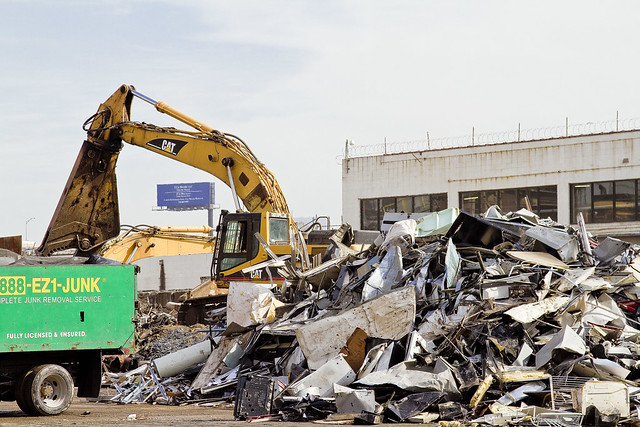
Rejoice, for this is the day when men and women return to their ancestral villages and seaside hamlets, gathering beneath cobbled roofs and behind garret windows to celebrate “America Recycles Day”. Children shall be offered solemn pledges and vast ritual amalgamations of litter will be assembled for display and dissemination. Many and varied will be the manifestations of this occasion, which is ultimately rooted in the solemn traditions set down by a group known as “Keep America Beautiful”.
from wikipedia
America Recycles Day (ARD) is the only nationally recognized day dedicated to encouraging Americans to recycle and buy recycled products. ARD is celebrated annually on November 15. The World Recycling Day celebrated in most countries, though falls on July 8. Thousands of events are held across the U.S. to raise awareness about the importance of recycling and to encourage Americans to sign personal pledges to recycle and buy products made from recycled materials.
– photo by Mitch Waxman
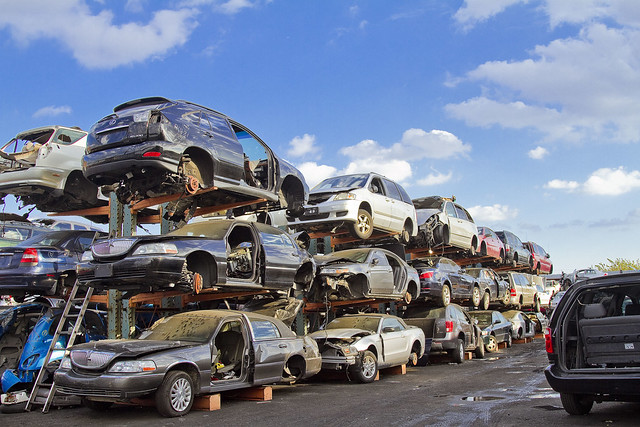
Gaze in astonished wonder at the industry of man, and the tyranny of wealth. Imagine, if you would, the raw tonnages of refined metals displayed in these shots. Surely, just in today’s posting, we are seeing a greater amount of waste metals than an entire nation might be capable of producing just a scant 200 years ago. We waste so much, and our culture- if nothing else- will prove itself a boon to future archaeologists.
The multitudinous middens of the megalopolis, well moistened with motor oil, will stand as our monument.
from wikipedia
Keep America Beautiful was founded in 1953 by consortium of American businesses (including founding member Philip Morris, Anheuser-Busch, PepsiCo, and Coca-Cola) nonprofit organizations, government agencies, and concerned individuals in reaction to the growing problem of highway litter that followed the construction of the Interstate Highway System, and an increasingly mobile and convenience-oriented American consumer. The original goal of the organization was to reduce litter through public service advertising (PSA) campaigns.
Keep America Beautiful conducted many local PSA campaigns early in its history. One of these early campaigns in Pennsylvania (PENNDOT), some attribute to having coined the term “litterbug”, as opposed to the New York Transit Authority. There is some confusion over the origin of the actual word “litterbug” due to several early uses of it in widespread public service advertisements. It was, in fact, coined by Paul B. Gioni, a copywriter in New York City who originated it for The American Ad Council in 1947. Keep America Beautiful joined with the Ad Council in 1961 to dramatize the idea that every individual must help protect against the terrible effects litter has on the environment.
A popular television campaign theme in 1963, with copy written by Paul B. Gioni who also coined the word “litterbug” in 1947, was “Every Litter Bit Hurts”. Another appeared in 1964 featuring character Susan Spotless. In 1970 KAB began distributing a free brochure; more than 100,000 copies were requested within 4 months.
On Earth Day 1971, a new campaign was launched with the theme “People Start Pollution. People can stop it” featuring the now iconic “Crying Indian” played by Iron Eyes Cody.

– photo by Mitch Waxman
Amongst those who tolerate my presence, some work in the recycling industry. A missive they ask a humble narrator to transmit reads as: “Recycle. Please. Don’t do it for us and our business, do it for your kids”. They continue that it’s probably already too late, and that the future is trashed. Perhaps, just perhaps, they are wrong. Until the ultimate answer is found to this disposables issue, they are likely being far more pragmatic than the rest of us. It is they, after all, who see the trucks tipping and collecting, and spend more time than they would like handling putrescent garbage as a loss leader.
Figuring out when, where and how to recycle in your community couldn’t be easier. Log on to www.americarecyclesday.org and select the “Find Recycling” tab and click on the Earth911.com logo. This will direct you their recycling resource page, where you can enter the item type and your zip code to find the nearest recycling facility.

– photo by Mitch Waxman
By no means should this humble narrator be considered a creature of primal intelligence, good hygiene, or high moral turpitude. Neither should it be inferred that the role of exemplar is claimed, as far as the contributions of my own household to the problem. A lone and singular advantage is that I am instead smart enough to realize how smart I’m not, and realize the shallow depths of my grasp on the situation. Around here, we just try not to be too loose with using things that can’t be washed, or reused, or cross purposed. How about you?
from wikipedia
Recycling statistics:
- 251 million – tons of trash in the United States
- 53.4 – percentage of all paper products recycled in the United States
- 32.5 – percentage of total waste that is recycled in the United States
- 100 – approximate percentage of increase in total recycling in the United States during the past decade
- 8,660 – number of curbside recycling programs in the United States in 2006
- 8,875 – number of curbside recycling programs in the United States in 2003
- 95 – percentage of energy saved by recycling an aluminum can, compared with manufacturing a new one
- 4.6 – pounds of trash per person per day in the United States (most in the world)
- 1.5 – pounds of recycled materials per person per day in the United States


 The Newtown Pentacle